

Classic fruit and triple-seven machines appear deceptively simple on the surface. Beneath the retro cherries, bars, and flaming sevens, however, modern high volatility mega 777 slots operate on some of the steepest mathematical variance curves in iGaming. Unlike modern video slots that spread Return to Player (RTP) across frequent low-value bonus triggers, high-variance 777 engines concentrate up to 75% of their theoretical payout pool into rare, top-heavy multiplier alignments.
Players routinely search for daily performance indicators like rtp live slot 777 or track community chatter around mega 777 slot gacor sessions. Yet surviving the extended dry spells inherent to these stripped-down reel architectures requires replacing guesswork with exact probability modeling: calculating hit frequency, multiplier wild compounding, and dead-spin capital endurance.
The Mathematical Engine: Hit Frequency and Paytable Skewness
To understand why classic 777 slot volatility feels vastly more punishing than standard cascading games, you must examine the paytable distribution. In a traditional 3-reel or compact 5-reel fixed-payline setup, the symbol set is intentionally restricted, creating wide mathematical gaps between non-winning spins and top-tier line hits. For a deeper look into foundational classic setups, review our strategic blueprint for Emas 777 slot players.

Analyzing 777 slot hit frequency reveals three structural realities:
- Compressed Hit Rate (14% to 20%): While medium-volatility video slots award minor wins on roughly 28% to 35% of spins, high-variance 777 titles often register winning combinations on fewer than 1 in 5 spins.
- Binary Payout Distribution: Most winning spins return between 1x and 4x the base bet—merely slowing bankroll erosion rather than generating profit.
- Top-Heavy Paytable Concentration: Achieving slot 777 max win outcomes relies entirely on landing full-screen Triple-7 combinations intersected by multiplier wilds.
Multiplier Wilds and Compounding Payline Math
The defining feature of modern mega 777 slot multiplier variants (such as 777 Strike, Fire Strike 2, or Mega 777) is how wild symbols interact across active paylines. Understanding multiplier wilds 777 math clarifies how a modest base symbol transforms into a massive payout.

Structural Comparison: 3-Reel vs. 5-Reel 777 Architectures
| Architecture Type | Base Hit Frequency | Multiplier Mechanic | Variance & Payout Profile |
|---|---|---|---|
| 3-Reel Single / 5-Payline | ~14% – 17% | Additive or multiplicative wilds (2x, 3x, 5x) on center/outer reels | Extreme 777 slot variance curve; long dead spins punctuated by 500x–2,500x hits |
| 5-Reel Fixed-Payline (10–20 Lines) | ~19% – 24% | Stacked Triple-7s combined with global multipliers or respin locks | High variance classic slots pacing with smoother balance retention via line overlap |
When two 3x multiplier wilds land on the same active payline alongside a high-tier Triple-7 symbol, the payout does not add (3x + 3x = 6x)—it compounds multiplicatively (3x × 3x = 9x the base symbol value). Identifying titles with slot 777 rtp tertinggi (96.50% and above) ensures the house edge remains minimal while waiting for these rare multiplicative intersections.
Debunking 777 Slot Myths: Patterns, Timings, and RNG Seeds
Because classic 777 machines lack complex animations or multi-stage bonus maps, players frequently look for external triggers to predict when a payout cycle is due. Search queries for pola slot 777 hari ini, trik menang slot 777, and bocoran slot 777 gacor reflect attempts to impose deterministic patterns onto an asynchronous system.
Similarly, tracking a specific jam gacor slot 777 assumes that server payout pools fill up and release at scheduled hours—a fallacy we also examined in our RTP live data and slot algorithm analysis. In certified gaming environments, any fixed payline 777 strategy must account for three cryptographic truths:
- Zero Reel Memory: A machine that has produced 45 consecutive dead spins has the exact same mathematical probability of landing Triple-7s on spin 46 as it did on spin 1.
- No “Due” Payout Cycles: Classic 777 slots do not operate on mechanical hopper limits. Every spin pulls an isolated microsecond seed from a certified Random Number Generator (RNG).
- Bet-Toggling Irrelevance: Alternating between minimum and maximum wagers (often recommended in cara main slot 777 menang guides) only changes your variance exposure—it never alters the underlying symbol weighting tables.
Dead-Spin Survival Math and Bankroll Allocation
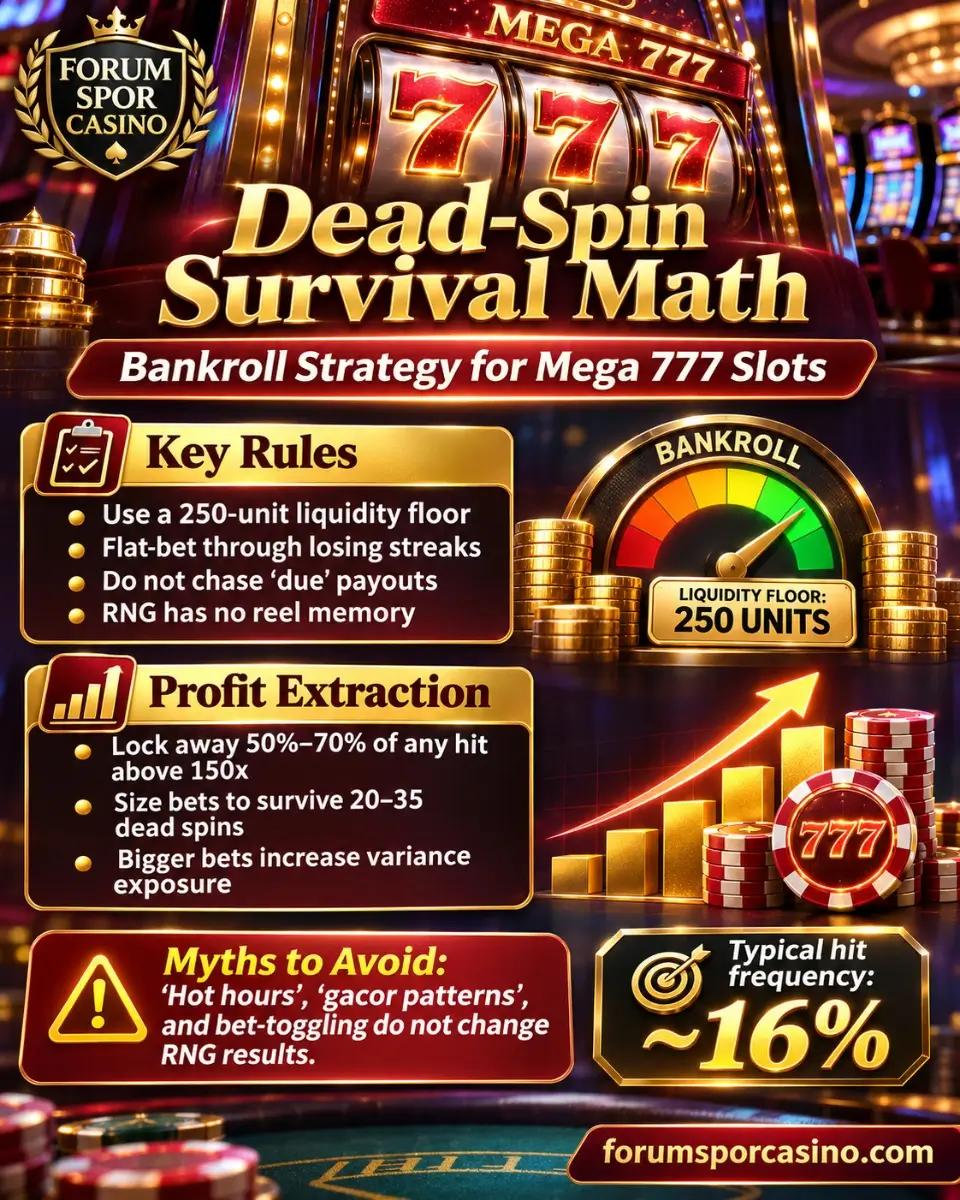
Executing an effective bankroll management 777 slots plan requires engineering your stake size around dead spins survival math. Because a 16% hit frequency regularly produces streaks of 20 to 35 consecutive losing spins, underfunded sessions almost always hit zero before encountering a high-tier multiplier combination. Integrating these rules with our high-variance slot bankroll management guide maximizes session longevity.
To mathematically survive negative variance cycles on high-volatility 777 titles:
- The 250-Unit Liquidity Floor: Divide your total session bankroll by at least 250 to determine your base spin size. If your session budget is $250, your maximum wager per spin should not exceed $1.00 (and ideally $0.50 for 3-reel extremes).
- Flat-Betting Discipline: Maintain a consistent unit size throughout the session. Escalating bets after 15 dead spins accelerates capital ruin during cold variance runs.
- Tiered Profit Extraction: Because multiplier line hits arrive in sudden spikes rather than gradual climbs, immediately lock away 50% to 70% of any single hit exceeding 150x your base stake.
🏆 Looking for Verified High-RTP Platforms?
Executing high-variance classic slot strategies requires an operator with certified RNG servers, full 96.50%+ RTP configurations, and transparent payout limits. Browse our audited reviews to find trusted platforms with instant withdrawals.
Explore Our Verified Reviews of the Best Betting Sites ➔📌 Recommended Reading: Slot Math & Strategy Hub
- The Mathematics of the Spin: A Strategic Blueprint for Emas 777 Slot Players
- Tips for Managing High Variance Slot Funds & Dead-Spin Endurance
- Pragmatic Play Buy Feature Analytics: Is the 100x Wager Worth the Math?
- Mahjong Ways Algorithm Masterclass: Decoding Volatility and Reel Mechanics
- Deconstructing Slot Turnover Bonus Requirements: The Math Behind Maximum ROI
❓ Frequently Asked Questions
Why do high-volatility Mega 777 slots have so many consecutive losing spins?
Classic 777 slots concentrate up to 75% of their theoretical RTP into rare, high-multiplier Triple-7 combinations rather than frequent small payouts. Consequently, their hit frequency typically sits between 14% and 20%, leading to longer dry streaks.
How do multiplier wilds calculate payouts in 777 slots?
In most modern Mega 777 titles, multiple wild multipliers landing on the same winning payline compound multiplicatively rather than additively—meaning two 3x wilds multiply the base line payout by 9x (3x × 3x).
Is a 3-reel or 5-reel 777 slot better for bankroll preservation?
A 5-reel fixed-payline 777 slot (with 10 to 20 lines) generally offers slightly smoother variance and higher hit frequency (~19%–24%) compared to 3-reel single-line engines, making it easier to manage during extended sessions.
What is the safest bankroll size for playing high-variance 777 machines?
Maintain a minimum liquidity floor of 250 base units (e.g., $250 for $1.00 spins or $125 for $0.50 spins) using flat-betting discipline to survive 25+ dead-spin streaks without depleting your balance.
⚠️ Responsible Gambling Notice: Slot probability models, hit frequency metrics, and bankroll formulas presented in this article are strictly for analytical and educational purposes. High-volatility classic slots carry significant financial risk and prolonged losing streaks. Always set strict deposit and loss limits, wager only discretionary funds, and seek assistance from certified support organizations if gambling negatively impacts your well-being.