

The transition of traditional tile-matching games into high-variance video slots has produced some of the most mathematically engaging mechanics in modern iGaming. At the center of this structural evolution is PG Soft’s flagship series, where understanding the core mahjong ways algorithm separates disciplined bankroll operators from casual players.
Unlike traditional fixed-payline machines, this architecture relies on a dynamic 5-reel, 4-row layout (expanding to 5 rows in its successor) driven by a certified Random Number Generator (RNG). Players routinely monitor daily volatility feeds like mahjong ways rtp live or look for peak statistical performance indicators through rtp mahjong ways hari ini. However, long-term profitability requires analyzing the underlying code: the interplay between cascading reels, symbol conversion tables, and progressive multiplier scaling.
The Mathematical Engine: Cascading Reels and Gold Symbol Transformations
The core appeal of the series lies in its reel architecture. Standard video slots evaluate paylines in isolated single-spin events. In contrast, this engine utilizes a cascading mechanism where winning symbols explode, allowing overhead tiles to drop into vacant positions during the same wagered spin.
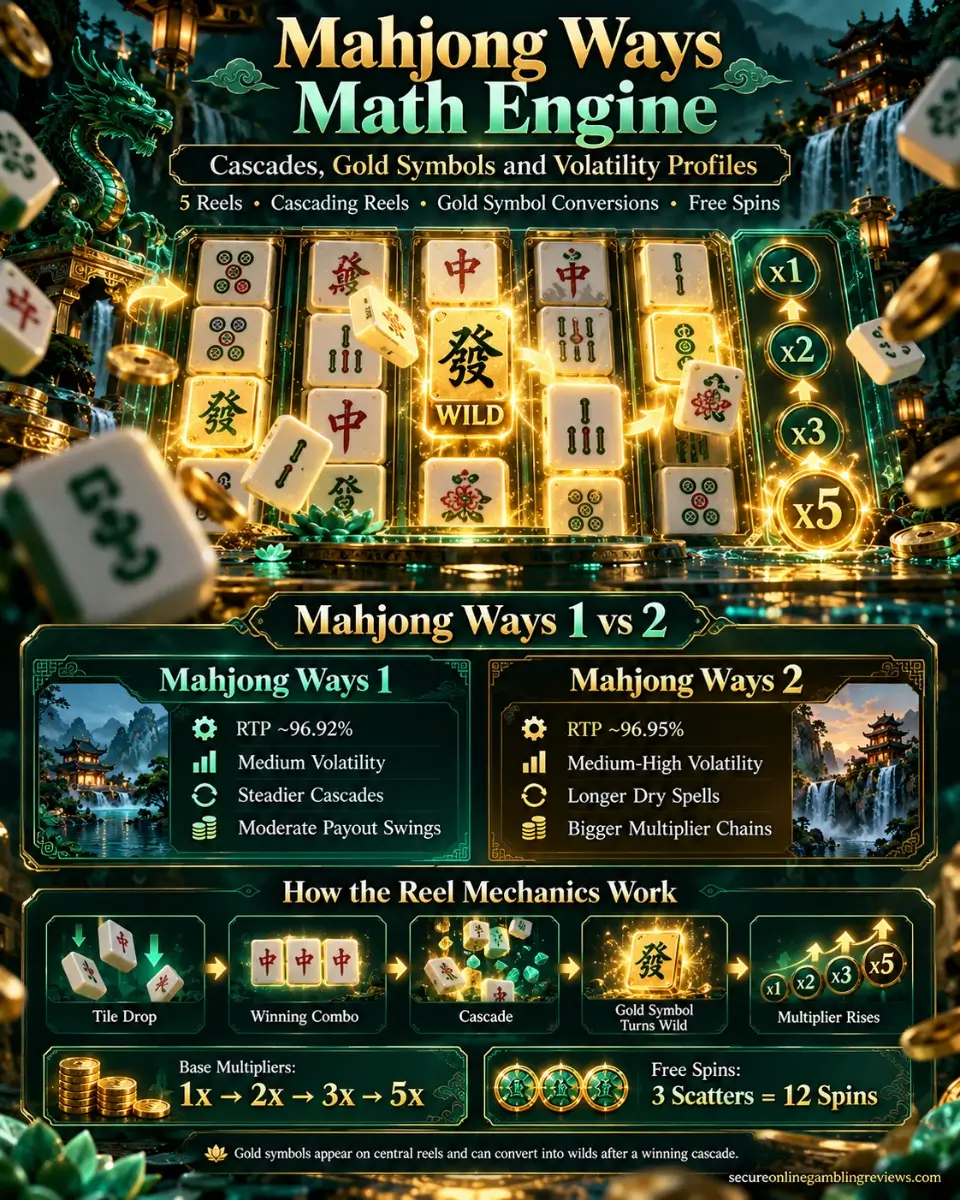
A critical element within this cascade cycle is the transformation of mahjong ways gold symbols. Appearing exclusively on reels 2, 3, and 4, tiles framed in gold that form part of a winning combination are automatically converted into wild symbols for the subsequent drop.
Structural Breakdown of Reel Mechanics
| Component | Base Game Mechanics | Free Spins Feature | Strategic Impact |
|---|---|---|---|
| Reel Layout | 5 Reels (4-5-5-5-4 configuration) | 5 Reels with Expanded Rows | Increases ways-to-win from 1,024 up to 2,000+ |
| Base Multipliers | 1x ➔ 2x ➔ 3x ➔ 5x | 2x ➔ 4x ➔ 6x ➔ 10x | Doubles overall return efficiency during feature triggers |
| Gold Symbol Mechanics | Flips to Wild upon payout | Flips to Wild upon payout | Creates chain-reaction wild connections across central reels |
| Scatter Requirement | 3 Ingot Scatters = 12 Free Spins | Retriggers (+2 spins per additional Scatter) | Essential for accessing the game’s high mahjong ways max win potential |
Understanding these mechanics transforms how players view community trends. Searches for a bocoran mahjong ways hari ini or a generalized bocoran slot mahjong ways focus on finding a single lucky moment. In practice, the engine relies on geometric multiplication: single-spin payouts compound exponentially when gold-framed tiles convert into central-reel wilds during a 5x multiplier cascade.
Comparative Math: mahjong ways 1 vs 2 Volatility Profiles
Choosing between the original release and its sequel requires analyzing their distinct volatility curves and theoretical returns. While both titles share a foundation, their underlying mathematical adjustments alter bankroll depletion rates significantly.
When comparing mahjong ways 1 vs 2, subtle structural modifications alter session dynamics:
- Row Configuration Expansion: The sequel expands the middle reels, increasing base combinations and enabling longer cascade chains.
- Multiplier Scaling: During the mahjong ways free spins feature, the sequel’s multiplier track doubles up to 10x, drastically shifting total Expected Value (EV) into the bonus round.
- RTP Calibration: While mahjong ways 2 rtp registers slightly higher on paper, its increased variance means bankroll swings are sharper, requiring larger capital reserves to survive dry cycles.

Many players attempt to bypass live variance by testing a mahjong ways slot demo to study cascade frequencies. While trial environments demonstrate how gold symbols convert to wilds, real-money sessions demand disciplined bet-sizing tailored to each title’s specific mahjong ways volatility profile.
Debunking Community Theories: Patterns, Timings, and High-Tier Scatters
The massive popularity of this game across global markets has birthed extensive community speculation regarding secret patterns and timing windows. Keywords like pola mahjong ways 2, trik mahjong ways 2, and cara menang mahjong ways reflect a widespread attempt to apply deterministic rules to an asynchronous algorithm.
Similarly, theories regarding a timed server pulse—frequently searched as jam gacor mahjong ways—assume that payout schedules fluctuate by time of day. In regulated environments utilizing certified cryptographic seeds, server response times remain uniform regardless of clock cycles.
Another prevalent myth involves high-tier scatter variants, such as the widely discussed mahjong ways scatter hitam. Community claims often suggest that specific tile color variations guarantee immediate high-tier multipliers or “gacor” phases (frequently tracked as mahjong ways 2 gacor).
From an algorithmic standpoint:
- Independent Randomness: Every spin calculation is entirely isolated from prior spins; the reel display simply renders the numerical output generated by the RNG microsecond seed.
- Fixed Trigger Thresholds: Scatter symbols maintain exact, hardcoded probability thresholds regardless of visual asset variations or external site claims.
- Symbol Mapping Integrity: A scatter tile functions purely as a feature-trigger flag. No external sequence or visual variant alters the underlying code governing bonus round payouts.
Capital Allocation and Multiplier Optimization
Navigating high-variance cascade engines requires moving away from superstitious spin patterns and focusing on clinical financial execution. Executing a successful mahjong ways multiplier strategy depends on calculating survival metrics that allow your balance to survive statistical downswings long enough to hit the high-multiplier cascades.
To maximize session efficiency without falling into emotional betting traps:
- Calculate Minimum Spin Liquidity: Maintain a balance equivalent to a minimum of 150 to 200 base bets. This buffer absorbs extended dead-spin cycles typical of medium-high volatility architectures.
- Avoid Bet-Spike Escalation: Doubling down during a losing streak (Martingale strategy) fails in cascade systems because dry spells can easily outlast balance reserves.
- Capitalize on Gold Density: Focus on sessions where middle-reel gold symbol density is high, as these position-based conversions generate the highest variance lifts.
- Enforce Hard Withdrawal Rules: Upon landing a major cascade chain during the 10x multiplier free spins, lock in a percentage of profits immediately rather than recycling capital into degraded variance cycles.
By recognizing that the mahjong ways cascading reels engine is a closed mathematical system governed by precise probabilities, operators can enjoy the game’s exceptional mechanics while maintaining total control over their financial risk.
🏆 Looking for Verified High-RTP Platforms?
Executing advanced slot strategies requires an operator with certified RNG algorithms and transparent payout schedules. Explore our thoroughly audited list of licensed casino platforms offering maximum security and instant withdrawal processing.
Explore Our Verified Reviews of the Best Betting Sites ➔❓ Frequently Asked Questions
How does the mahjong ways algorithm calculate cascading wild transformations?
The algorithm evaluates winning combinations on reels 2, 3, and 4. Any gold-framed symbol that forms part of a payout explodes and transforms into a solid Wild symbol for the immediate subsequent cascade, remaining until cleared by another win or sequence end.
Is there a mathematical difference between Mahjong Ways 1 and Mahjong Ways 2?
Yes. Mahjong Ways 2 features an expanded reel layout, a higher maximum multiplier potential during free spins (up to 10x), and a slightly higher theoretical RTP (~96.95%), accompanied by a higher overall volatility curve requiring larger capital buffers.
Do specific spin patterns (pola) or times of day (jam gacor) alter payout odds?
No. Regulated PG Soft slots utilize certified microsecond Random Number Generators (RNGs). Every individual spin is mathematically independent, making timing patterns, spin speed adjustments, or clock cycles completely irrelevant to payout probabilities.
What is the recommended bankroll sizing for playing high-variance cascade slots?
It is mathematically optimal to maintain a liquidity buffer equal to 150 to 200 base bets. This prevents account depletion during mandatory variance downswings while waiting for gold symbol conversions and feature triggers.
⚠️ Responsible Gambling Notice: Slot machine algorithms and payout mechanics described in this article operate strictly on certified Random Number Generators (RNG) and are intended for analytical and educational purposes only. Gambling involves significant financial risk and can lead to behavioral addiction. Always establish strict stop-loss limits, wager only discretionary funds, and never chase losses. If you or someone you know requires assistance with gambling-related harm, please contact your national support helpline.